
Category: news

  • Multiplex Movements

    We’ve just updated the pages for our North Wales & West Cheshire multiplexes, our Gloucestershire and Herefordshire & Worcestershire multiplexes and our Surrey & Sussex multiplex.

    We have requested to merge what was North East Wales & West Cheshire with what was North Wales to create a single multiplex. We have also requested to simulcast the same set of services on both the Herefordshire & Worcestershire and Gloucestershire multiplexes.

    I just wanted to write a few lines outlining our thinking about this. With North Wales we were seeing that many of our service providers would be appearing on both multiplexes and that the westerly multiplex would always be hard to make economically viable on its own. There was also a disappointment that the westerly side would take a little longer time in getting around to. By merging these multiplexes we hope to fix some of these issues and give more of Wales DAB quicker than had been envisaged.

    The simulcast of Herefordshire & Worcestershire and Gloucestershire was a harder decision to take especially as listeners in this area tend to look to different areas. We think that there will eventually be demand from service providers to fill both sides separately. However, at the moment (and with all the recent changes to stations in that area) it makes the multiplexes more viable to initially address these multiplexes as a single area. When demand increases, we will then be able to split the multiplexes into their two constituent parts.

    We’ve also taken a look at the Surrey & Sussex multiplex and feel it would make more sense for Arqiva to increase their Sussex Coast multiplex to cover more of Sussex and for the MuxCo multiplex to better concentrate on Surrey. As this involves another party, there’s still some more work to be done before we can talk about the plans for these areas. That’s also reflected in its current line-up.

    We’ve made these requests to Ofcom as part of their recent work on the future size and make-up of local digital radio multiplexes.

    Making Changes

    When the multiplexes were awarded, the radio environment was very different to what it is today. As a multiplex operator MuxCo works with different shareholder companies in each area, as well as maintaining a dialogue with the BBC and the local broadcasters about their thoughts and plans. We’ve always been big believers in digital radio, but it’s absolutely vital to have the agreement from shareholders and service providers before we can launch in each area. Were we to launch without this support, and with no tenants, the business would not last very long – it’s also unlikely that a new operator that would be able to succeed without this support as well. We’re genuinely trying to create something that’s sustainable in each area.

    Where we are now is that our partners and service providers feel much more confident about the industry and their own future and many are keen that the multiplexes launch so they can grow and develop their businesses. We’ve therefore updated our line-up pages with our current thoughts about service providers for these first areas. An important caveat – these are not the confirmed and final line-ups – there will be some additions (and always the chance of removals as well) – but in the interests of being open – this is what we’re currently building our plans around. It’s also dependent, of course, on regulatory approval. If there’s a station that you think should be on one of the multiplexes, the best thing to do is ‘politely’ request to that station that it should be made available on DAB in that area.

    Next stages

    There’s currently parallel activity going on. Whilst we’re waiting for approval from Ofcom for our changes we’re in the final operational planning stages with our transmission contractor so we can set a launch date for our first two multiplexes. We hope to announce some dates in the coming weeks.

    We’re aware that all of this has been a long time coming and I have to say that we are as frustrated as you that it has taken so long. I can only apologise for the delays and hope that you will find this news and some of the forthcoming updates as being more positive.
  • Progress

    Meeting

    Hello.

    We’ve been reading and replying to lots of the comments you’ve been writing and I thought it was probably time for a blog update.

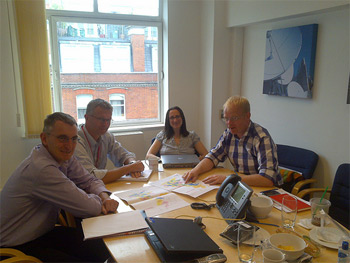
    To prove that there are some developments, honest, I snapped the picture above at a meeting we had recently. From the left David Peters and Paul Eaton (from Arqiva) and Nicky Tate and Gregory Wastson (from Folder Media/MuxCo). We met up to discuss the current situation and progress on the multiplexes. But what does that really mean?

    First we compared notes on what we think is happening to local multiplexes across the UK, whether we felt that any were likely to merge or change shape, and whether this would affect frequency allocation or availability of frequencies. We then talked about our own areas and the pros and cons of combining any areas and especially what this would mean for frequencies – ie would we want to use one frequency for any enlarged areas or would we want to maintain the existing allocations and muxticast a combined multiplex across two frequencies. We were also weighing up the affect this could have over coverage (positive and negative) and how it would impact or benefit potential service providers. We’re now going to be investigating some our thoughts with Ofcom’s technical teams.

    One question we’re asked, is why change anything? Well, for me the key thing is looking at whether any of the industry changes will mean we can have better coverage for less money. I’m also keen to maximise the flexibility on the multiplexes going forward and to allow us to provide innovative (read cheap) solutions for service providers. In DAB’s current development, is it better to cover larger local areas with some services that might traditionally appear on neighbouring multiplexes in the short term, and then split the multiplexes again when demand increases later on? Or does it really not make that much difference and should we proceed as planned? They’re the kind of decisions we’re making.

    We also had some good discussions with Arqiva about how the contribution part (ie stations getting their signals to the multiplex) as well as the distribution (getting the multiplex feed) to the transmitters. Contribution is usually a fixed cost, whereas the cost of capacity depends on bitrates, therfore for smaller services it will be good to try and drive that cost down and hopefully encourage services to join the multiplex and to allow short-term services to take part as well.

    All these discussions mean that Arqiva can now give us some firm quotations for the transmission costs of some of the earlier multiplexes planned. We can then move to final negotiations with them and then set prices for the service providers – allowing us to formally contract with them for carriage.  Then we can give Arqiva the OK to build the network, and away we’ll go!

    Matt.

  • MuxCo Welcomes Digital Britain

    digitalbritain

    The UK Government published its Digital Britain White Paper on 16 June. The key points of the report in relation to radio are:

    Digital migration

    • Confirmation of a digital radio “upgrade” by the end of 2015 (and which will be confirmed at least two years in advance).
    • All national and local services currently on DAB to migrate from analogue.
    • Small ultra-local stations and community radio to upgrade from MW to FM, or remain on FM.
    • Target for criteria (i.e. 50% of listening to be digital; national DAB coverage comparable to FM; and local DAB to reach 90% of population) to be met by 2013.
    • Five point plan for DAB in vehicles, supported by major car manufacturers including Ford and Vauxhall.

    DAB coverage

    • BBC to achieve comparable coverage to FM for its national multiplex by the end of 2014.
    • BBC to bear significant proportion of the costs of local DAB coverage roll-out.
    • Some cost savings delivered by Digital Britain to be re-invested to support transmitter investment.
    • Government will support a re-plan of local and regional DAB (merging multiplexes where agreed, and creating a second national multiplex).

    The White Paper is very positive and is supported cross party.

    In overall terms, we at Folder Media / MuxCo support the proposals in the White Paper, which we believe will help underpin DAB.
    In summary:

    • We support a set date for switch over, rather than a rolling set of criteria. This gives a clear flag to achieve, and we feel confident that the radio industry will be able to achieve the criteria by 2013.

    • We have always advocated that DAB is one of several digital radio platforms, and is likely to continue to be the primary terrestrial platform in the short to medium term, and hopefully longer.

    • We support the proposal for clear labelling of the DAB technology.

    • We have been involved in the initial industry discussions about converting the regional DAB layer into the basis of a second national layer and in principle support the proposal.

    • We have been involved in the initial industry discussions about ‘merging’ multiplex areas. We support the view that where such mergers make economic and efficiency sense for both multiplex operators and service providers, then the multiplex operator should have the right to approach Ofcom to merge, but that merging should not be artificially forced upon multiplexes. In addition, any re-plan needs to take account of potential long term interest rather than a short term view.

    • We have always stated that functionality and interactivity will be the bedrock of DAB, hence our intention to hold capacity for the provision of data rather than audio services. We currently maintain a watching brief on this aspect of the opportunity, as whilst we can create services, we need devices on which they can operate. To that end, we have good relationships with a number of manufacturers.

    Through the MuxCo application process we interviewed thousands of people who are current DAB listeners as well as those who had not yet taken the plunge. Current listeners are nearly all huge advocates for the technology and how it has improved their radio listening. We’re keen to work hard to make digital radio an even better proposition – coverage, content and features – and we’ll work strongly with all radio operators and the Government to provide a service that betters listeners’ analogue radio experience and keeps radio a vibrant medium.

  • MuxCo updates plans for a New DAB Digital Radio Multiplex serving Liverpool, Cheshire and North Wales

    MuxCo updates plans for its new DAB Digital Radio multiplex that will serve Liverpool, Cheshire and North Wales.

    Using transmitters at Moel-y-Parc, Wrexham Rhos and St.John’s Beacon, the multiplex will serve around 1.4m adults (15+) and enabling a range of existing and new services to broadcast in digital.

    The multiplex will carry BBC Radio Wales, BBC Radio Cymru, 107.6 Juice FM and Dee 106.3, allowing these existing services to both broadcast in digital quality and be heard by a wider audience than can currently hear them on analogue. In addition, the multiplex will carry a number of new services, only available on DAB Digital Radio. These will include Traffic Radio, a 24/7 traffic news and information service from the Highways Agency, a new music service from Town & Country Broadcasting and a range of data services from Folder Media.

    The multiplex has opportunities for additional radio services to join this exciting multiplex.

    MuxCo is currently finalising its contract with Arqiva, with proposals for the multiplex to launch in the second half of 2010.

    More news to follow soon.

  • MuxCo welcomes the findings of the Digital Radio Working Group

    The Digital Radio Working Group (‘DRWG’) has today (19 Dec 2008) published its final report on the status and strategy for digital radio.

    In the UK, 31.4% of all adults every week currently listen to radio via a digital radio platform, and this results in the digital platforms having a total share of all radio listening of 18.7% (Rajar Q3 2008).  DAB is and is set to remain the principal digital radio platform – 8m sets sold to date, and DAB accounts for over 11% of total listening.

    MuxCo agrees with the DRWG that a radio-specific broadcast platform is an essential part of radio’s future and that “DAB, unlike both DTT and the internet, is the most effective and financially viable way of delivering digital radio, particularly large local radio services, for the foreseeable future”.

    We welcome the DRWG’s suggestions for a migration path which would be triggered by at least 50% of total radio listening is to digital platforms, and that the DRWG believe this could be achieved between 2015 and 2020.

    Gregory Watson, MD at MuxCo, says “It is great news that the Digital Radio Working Group, and its members which include the BBC, Radiocentre and DRDB, has reaffirmed its commitment to the development of a sustainable and successful digital future for radio.    Today’s announcement gives us even more comfort with the development of DAB.  We look forward to the publication of the Government’s Digital Britain Report in early 2009, and urge Government and Ofcom to consider the recommendations set out in the DRWG report”.

    The full DRWG report can be downloaded http://www.culture.gov.uk/reference_library/publications/5700.aspx

  • Boo.

    Big sighs at MuxCo HQ as we’ve just found out that we’ve sadly not been awarded the licence for Herts, Beds and Bucks. It’s  instead been awarded to GCap subsidiary NOWdigital. Congratulations to Matt and Nicky at NOWdigital for putting together a winning application.

    Succesful or not however, we believe strongly in our model for local multiplexes and that for digital radio to grow and develop that there needs to be a solid opportunity for all broadcasters large and small to take part. We’re very happy with our recent applications for Northeast Wales and West Cheshire and Herefordshire and Worcestershire and we’re working hard to put together great bids for more areas that are being advertised.

    Right, time for a beer.

  • MuxCo is Live

    It’s been a busy few months but we’ve finally gone public with MuxCo. Our application for the Herts, Beds and Bucks multiplex will be the first of many bringing, we hope, a new way of doing local digital radio.

    As you can see from our Herts, Beds and Bucks page we’ve got a different kind of line-up of services and a different kind of shareholder structure. Our aim is to make each multiplex as local as possible. We do this by having some of our local service providers as shareholders. This reduces the cost of their digital transmission (as they receive dividends from the compnay) and encourages them to broadcast on DAB,  usually earlier then they might have chosen, which we think is great news for consumers.

    Why is this different? Well, think of a multiplex as a house. Normally one person gets a mortage on a house and they rent out some of the rooms to other people and they keep a few for themselves. They always hope that the money that comes from the rent will actually cover the cost of the entire mortgage, which means they get to live rent free or at least at a reduced rate.

    Multiplexes are usually very similar, one operator broadcasts some of their own stations and hopes the rent from all of the others will off-set some (or all) of their costs.

    With MuxCo it’s a bit like you’ve got together with your friends to buy a house, there’s still a little bit of money coming in from a few lodgers but generally you all benefit from owning the house together. This keeps the costs down and means you can spend more money or doing up your room – or for radio stations, spending more money on content.

    Before that analogy gets a little too tortuous I think I better stop there. You can always leaves comments here on the blog, or email me [email protected].